
The Challenge of Living on Irregular Income
Freelancers and gig workers live with a fundamental challenge: income rarely arrives in steady, predictable paycheques. Some months bring plenty of work, others are quiet, and late invoices can turn a strong month into a stressful one. Rent or mortgage payments, utilities, groceries and debt repayments, however, still arrive on schedule. In higher cost, developed economies, that clash between volatile income and fixed expenses can create persistent financial pressure.
Traditional budgeting methods tend to assume a stable monthly salary, so they do not always translate well to freelance realities. Yet operating without any structure at all may lead to missed bills, rising credit card balances and a constant sense of uncertainty. Managing irregular income is less about eliminating risk and more about creating systems that can absorb volatility.
Why Standard Budgets Don't Fit Freelancers
Most standard budgeting advice starts from a fixed figure: your monthly salary. You then allocate that amount across housing, bills, food, transport, savings and discretionary spending. For salaried employees, this can be straightforward. Freelancers rarely have that level of predictability.
A designer might earn the equivalent of three months of income from a single project and then go weeks without a new brief. A driver or delivery worker may see earnings change with weather, holidays and demand, sometimes from one week to the next. If you try to treat each month as identical in this context, you risk over committing after good periods and struggling when work slows. Instead of assuming every month will look like your best month, it is usually safer to plan around more conservative figures.
1: Build a Realistic Income Baseline
The starting point for managing irregular income is understanding what you actually earn over time. That means looking at a meaningful period—often the last 6–12 months—rather than focusing on a single good or bad month. Add up your income for that period and divide by the number of months to get an average monthly figure.
To be more cautious, you can give greater weight to leaner months. For example, if your recent monthly income has ranged between 2,000 and 4,000 in your local currency, you might base your core budget on 2,000–2,500 rather than the full average. This helps avoid building a lifestyle around unusually strong periods that may not repeat. The goal is not to forecast every invoice but to create a baseline that your budget can reasonably support.
2: Understand Your Essential, Variable and Irregular Costs
Once you have a baseline, you need a clear view of your outgoings. Separating them into categories helps you see where you can adjust and where you cannot.
Essential expenses are the costs you must pay to keep a roof over your head and maintain basic living standards: housing, minimum debt payments, basic insurance, and often childcare. Variable expenses include groceries, transport, utilities and flexible items such as entertainment and non essential shopping. Irregular costs—such as annual software subscriptions, professional memberships, equipment replacement, tax payments or major car repairs—do not occur every month but are still part of your real cost of living.
Looking at several months of transactions and tagging them into these groups can highlight where most of your money goes. For many freelancers, this exercise reveals that fixed obligations already use a large share of their conservative income, leaving limited room for fluctuations. Recognising that early can guide more cautious decisions about, for example, taking on new recurring commitments.
3: Use a Buffer or Holding Account to Smooth Cash Flow
One of the most effective ways to make irregular income more manageable is to separate when you are paid from when you pay yourself. A buffer or holding account can be central to that strategy.
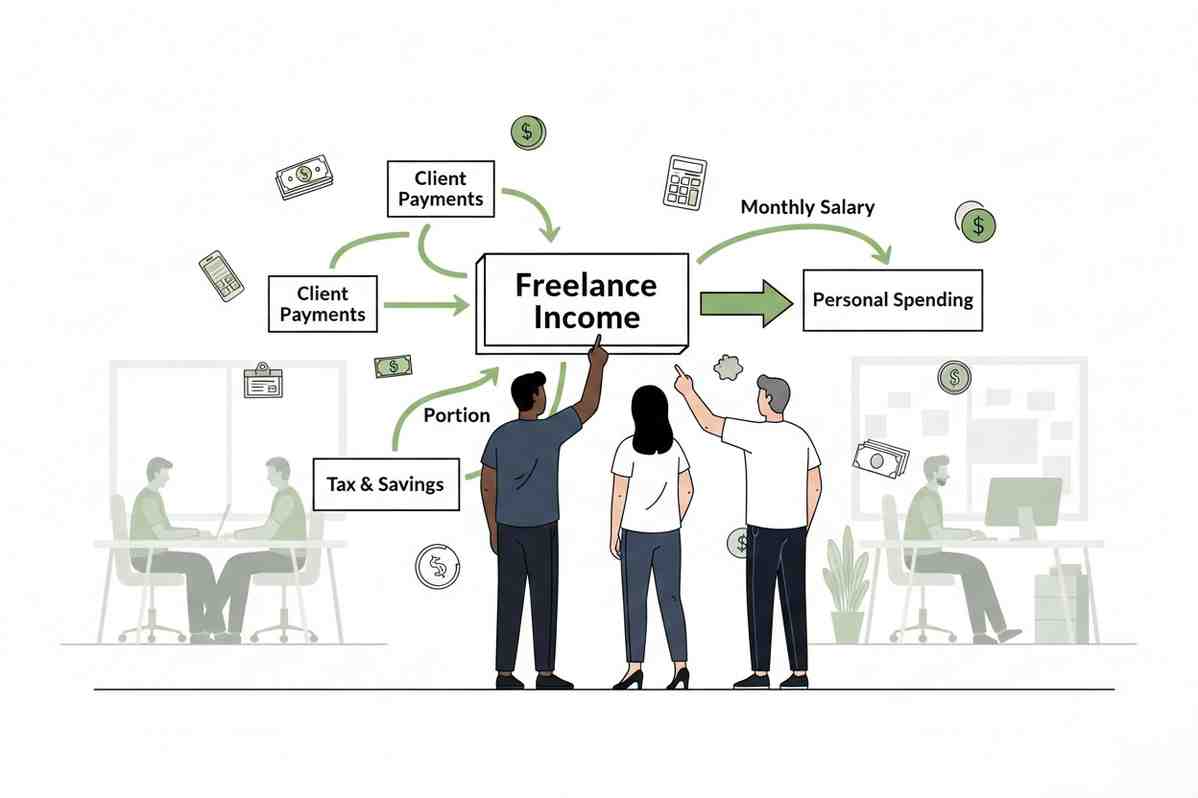
In practice, you can route all freelance and gig payments into a dedicated income account. From that account, you transfer a fixed "salary" into your personal spending account on a regular schedule—often monthly, but weekly can work for some people. The amount of that transfer is based on your conservative income baseline, not on what happened in the most recent week. When you have a high earning month, the surplus stays in the income account and builds a cushion. When a quieter month arrives, you can maintain your usual draw by using part of that buffer.
For instance, a freelance web developer might have a very busy quarter, during which the buffer grows enough to cover several of their standard monthly transfers. When work slows later in the year, they keep their personal income stable by drawing down the buffer instead of reacting to each uneven payment.
4: Prioritise Essentials and Treat Savings as Non Negotiable
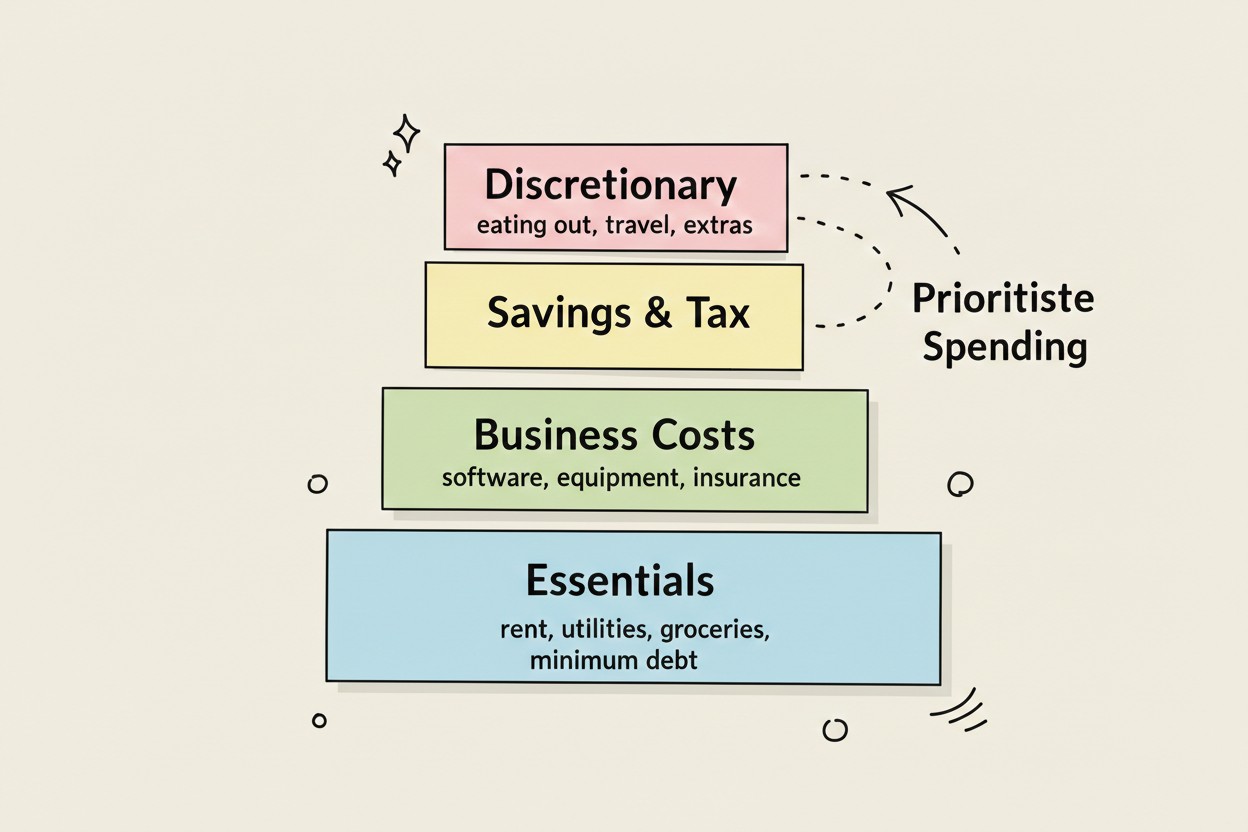
With irregular income, prioritising how you use your "salary" from the buffer is crucial. The first layer usually goes to essential living costs: housing, utilities, basic food, essential transport and minimum payments on any debts. Business costs that keep you able to earn—like core software, insurance and equipment maintenance—also sit near the top of the list.
After that, it is helpful to treat savings as a planned expense rather than a bonus. This can include an emergency fund, tax savings and longer term goals such as retirement. Even modest, regular contributions during better months can soften the impact of slower periods. Only after these priorities are covered does it make sense to allocate money to discretionary spending, such as dining out, holidays or non essential shopping.
Structuring your budget in layers—essentials first, then business costs, then savings, then discretionary spending—makes it easier to know what to adjust if income drops. You may cut or pause some discretionary items temporarily while keeping the fundamentals intact.
5: Plan Ahead for Taxes and Business Expenses
Handling your own tax obligations is a key part of freelance life. When income fluctuates, it can be tempting to treat every payment as available cash, but that increases the risk of being caught short when tax bills or advance payments fall due.
A common practice is to set aside a percentage of each payment in a separate tax savings account as soon as the money arrives. The right percentage depends on local tax rules, your overall income and deductible business costs, so many people choose a conservative figure until they have more precise guidance from a tax professional. Keeping this money separate reduces the temptation to spend it and can make tax season less stressful.
It is also helpful to budget explicitly for business expenses such as software licences, equipment replacement, professional insurance, marketing and accounting support. Treating these as planned investments in your work, rather than ad hoc costs, can make your finances more predictable and your tax reporting simpler.
6: Review and Adjust the Plan Regularly
Because freelance income can change quickly, your plan needs to be revisited regularly. A monthly review is a useful rhythm for many people, though those with highly variable weekly earnings may prefer more frequent check ins.
In each review, compare what you actually earned and spent with your plan. If income has been consistently above your baseline for several months, you might decide to increase your buffer, make extra debt repayments, or raise your savings contributions rather than immediately expanding your lifestyle. If income has been below expectations, you may need to tighten discretionary spending, delay some purchases or temporarily reduce your personal "salary" from the buffer.
This ongoing adjustment acknowledges that freelancing is dynamic. The plan is there to guide decisions, not to lock you into numbers that no longer fit.
7: Common Pitfalls for Freelancers with Variable Income
Several patterns tend to trip up freelancers and gig workers, regardless of field. Recognising them early can help you avoid them.
One is treating unusually strong months as typical and upgrading recurring commitments—such as rent, car payments or subscriptions—to match. When income falls back to its normal range, the higher fixed costs remain. Another is neglecting basic record keeping: without tracking invoices, due dates and payments, it becomes hard to see who owes you money or to spot trends in your earnings.
Heavy reliance on credit to cover routine gaps is another risk. Borrowing may seem like a quick fix, but if balances are not repaid promptly, interest charges can erode future income. Finally, underestimating tax obligations or leaving them until the last moment can produce avoidable stress and potential penalties. Building habits and systems to address these areas is often more effective than relying on memory or willpower alone.
Real World Ways Freelancers Apply These Ideas
Consider a marketing consultant whose workload is heavily skewed to the final quarter of the year. Rather than letting spending rise each time a large invoice is paid, they send all income to a dedicated account and pay themselves a consistent amount each month based on a cautious estimate of their typical earnings. The surplus stays in the buffer to support quieter months.
Another example might be a part time gig worker who combines several platforms. They set a minimum income target that covers essentials and track earnings weekly. Anything above that target is split between an emergency fund, tax savings and a small amount of discretionary spending. When demand dips, they reduce non essential costs first, while trying to preserve contributions to their buffer and tax savings.
Risks, Limitations and When to Seek Advice
No budgeting system can remove all the uncertainty of self employment. Clients can disappear, platforms can change their rules, and health issues or caring responsibilities can affect your ability to work. Even a well funded buffer has limits if income falls sharply for a long time.
Tax, social security and benefit systems also vary significantly between countries and may change over time. A strategy that works for one person may not be suitable for another with different obligations, dependants or legal structures. General information, such as the guidance here, cannot account for all those differences or your personal circumstances. If you have complex tax questions, significant debt, or dependants relying on your income, it can be wise to speak with a licensed financial adviser, accountant or tax professional familiar with freelancers in your jurisdiction.
Conclusion: Bringing Stability to an Unpredictable Income
Managing irregular income as a freelancer or gig worker is not about eliminating volatility but about building structures that make it more manageable. Establishing a realistic income baseline, separating business and personal money, using a buffer account, prioritising essentials and planning for taxes and savings can all help you navigate uneven earnings with more confidence.
These strategies cannot guarantee any outcome, but they can reduce stress and support more deliberate choices about your work and spending. If you find it difficult to build or maintain such a system on your own, professional advice can provide additional clarity and help you adapt these ideas to your situation.


